A Day in the Life of a Family HUF Manager: Running 4 Demat Accounts in Under 10 Minutes a Day
Managing your own, your spouse’s, your parents’, and your HUF account does not have to eat your day. Here is a simple three step routine that keeps four demat accounts in sync in under 10 minutes.

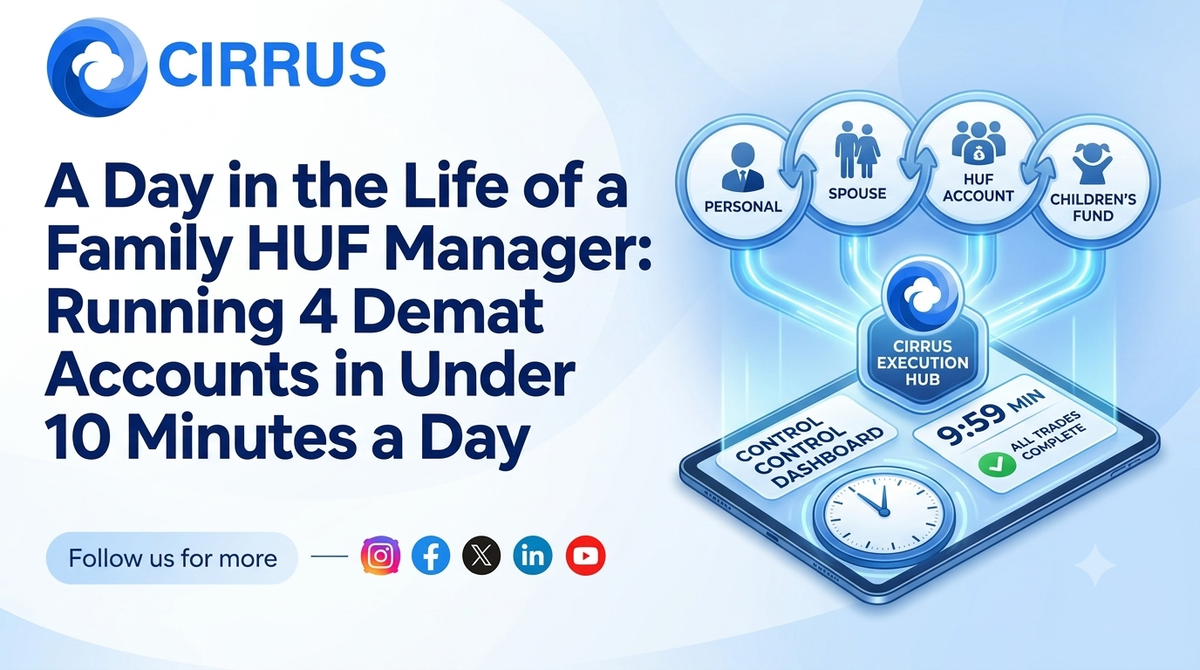
If you look after your own portfolio, your spouse’s account, your parents’ holdings, and the family HUF, you already know the real cost is not the trading. It is the logging in, switching tabs, re-checking quantities, and wondering whether all four accounts actually got the same trade.
This is a composite walkthrough of how a family account manager can structure the day so the routine takes under 10 minutes. The example is illustrative, not a record of any one person.
The Short Answer: Can You Really Manage 4 Demat Accounts in Under 10 Minutes a Day?
Yes, if the setup does the repetitive work for you. The time goes into one planning step and one review step. The order placement itself runs from a single signal across all linked accounts, instead of four separate manual sessions.
The Old Routine: Where the Time Actually Goes
Without a connected setup, a typical day looks like this:
- Log in to each broker, handle fresh 2FA, and wait for sessions to load.
- Place the same order four times, adjusting the quantity for each account by hand.
- Check each account separately for fills, rejections, and margin.
- Repeat the exit in all four accounts, hoping the price has not moved in between.
Add SEBI’s static IP expectations and daily session resets for API access, and the do-it-yourself automation route has become harder than it used to be. Dynamic home networks and unverified scripts are increasingly rejected by brokers.
The New Routine: A Day in 3 Short Steps
Morning, about 3 minutes: Check and confirm. Open the terminal, confirm all four broker connections are active after the daily token refresh, and glance at available margin in each account. Nothing is placed yet.
During market hours, about 3 minutes: One signal, all accounts. When your setup triggers, whether from the terminal or a TradingView or Chartink alert, the order is sent once and routed to every linked account in parallel. Each account’s quantity follows the ratio you set earlier, such as 100% for your own account, 50% for your spouse, and 25% for the HUF.
Evening, about 3 minutes: Review. Look at fills and any rejections in one place, note anything that needs follow-up, and close the day. The whole routine stays near the 10 minute mark.
How Cirrus Fits Into This Routine
The routine only works if the compliance and sizing layers are handled in the background. Here is what Cirrus covers:
- Native Static IP Binding: Orders reach connected brokers through whitelisted static IP architecture, so you do not run a server or manage IP whitelisting yourself.
- Single Signal, Multi-Account Fills: One webhook or terminal action becomes parallel order requests for each linked broker account.
- Smart Lot Multipliers: Set the ratio for each account once. A 4 lot Nifty trade can scale to 4 lots, 2 lots, and 1 lot across different accounts without manual math.
Frequently Asked Questions (FAQs)
1. Is it legal to manage a spouse’s, parents’, or HUF demat account? Managing accounts through official broker APIs and authorized login tokens is permitted when you are authorized to operate them. A HUF is typically operated by its Karta. Confirm authorization and each broker’s rules for every account.
2. Do I need to log in to all four brokers every day? Session tokens reset daily, so each connection needs fresh authentication. A connected terminal keeps this in one place so you are not juggling four separate screens.
3. What if one account has a margin rejection? Each account is checked against its own margin, so a rejection in one account does not automatically stop the others. Review rejections in your end of day check and adjust quantities if needed.
4. Do I need coding skills or my own server? No. Cirrus is a cloud-based web terminal. Static IP routing, token handling, and multi-broker connections run on secure cloud servers.
5. Does this guarantee better returns? No. It saves time and reduces execution mismatch across accounts. It does not improve your strategy or remove market risk.
At a Glance: Key Takeaways
What It Means for a Busy Family Manager
Looking after family accounts is a responsibility, and rushed manual work is where mistakes happen: a wrong quantity, a missed exit, or an account left behind. A short, repeatable routine lowers that risk and gives you back time for the research that actually matters.
The Bottom Line: You do not need institutional infrastructure to manage four accounts well. You need a compliant, connected setup and a simple daily routine built around it.
Want to run your family accounts with a shorter daily routine? Explore how Cirrus automates multi-broker execution across major Indian brokers with built-in static IP routing.
Key Facts at a Glance for Quick Reference
Disclaimer: Investments in securities markets are subject to market risks. Read all related documents carefully before investing. The daily routine described here is a composite illustration and does not represent any real person, actual trades, or guaranteed results. KuberHunt and Cirrus do not provide investment advice through this content. Time savings and outcomes depend on your setup, broker systems, and market conditions. Please verify account authorization and broker rules before operating any account on behalf of others.