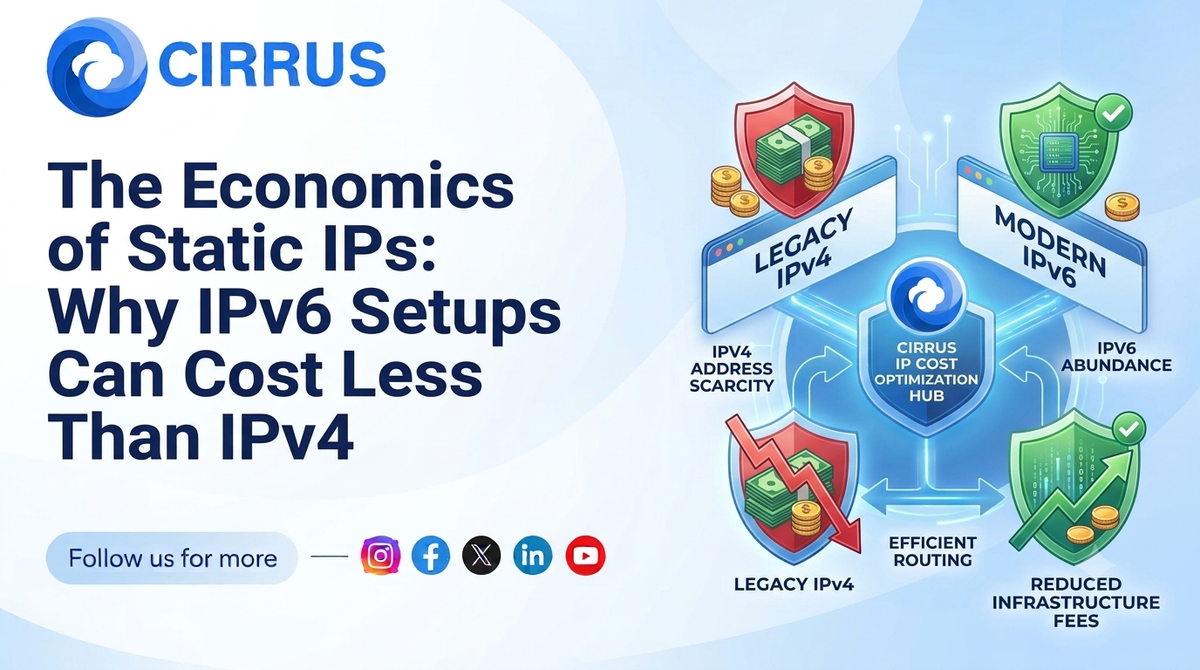
The Economics of Static IPs: Why IPv6 Setups Can Cost Less Than IPv4

Ever since SEBI’s static IP rules for broker APIs took effect, a new line item has appeared in many traders’ budgets: the cost of a fixed IP address. If you manage more than one account, that cost can multiply quickly.
Many traders do not realise that the type of IP address you use, IPv4 or IPv6, can change what you pay. This guide explains why, and where the savings stop.
The Short Answer: Is IPv6 Cheaper Than IPv4 for Static IP Trading?
Often, yes. IPv4 addresses are scarce, and cloud providers commonly bill for them separately, while IPv6 addresses are generally free. But the savings only apply if your broker accepts IPv6 whitelisting and every service your setup talks to handles IPv6 properly. Broker support is not uniform.
Why IPv4 Costs More
Three things push IPv4 costs up:
- Scarcity: The pool of IPv4 addresses is limited, so providers treat each one as a billable resource.
- Separate billing: On many cloud platforms, a reserved IPv4 address is charged on top of the server itself.
- One IP per client: Some brokers require each client to use their own static IP. If you run several accounts, you may need several addresses, and the cost adds up.
IPv6 removes much of this pressure, because address supply is not a constraint.
Where IPv6 Savings Run Out
Cheaper does not always mean easier. Before switching, check these:
- Broker support: Some brokers accept both IPv4 and IPv6 for whitelisting, while others currently support only IPv4 and list IPv6 as coming soon.
- Other services: Your setup rarely talks only to the broker. Data feeds, alert tools, and proxies may not route IPv6 traffic reliably, which can cause failures that are hard to debug.
- Reliability over price: A very low cost setup can bring variable uptime and network quality. A rejected order costs far more than a saved monthly fee.
The Real Cost Is More Than the IP Address
The address is only one part of the bill. A do-it-yourself static IP setup can include:
- The static IP itself, from an ISP or a cloud provider
- A server or VPS to run your orders from
- Time spent configuring, whitelisting, and refreshing daily sessions
- Repeating the setup for each account that needs its own IP
Seen this way, the cheapest address is not always the cheapest setup.
How Cirrus Changes the Cost Equation
Cirrus moves the static IP layer into the cloud, so you do not buy and manage addresses and servers yourself. Here is what it covers:
- Native Static IP Binding: Orders reach connected brokers through whitelisted, SEBI-compliant static IP architecture, with no server configuration on your side.
- Single Signal, Multi-Account Fills: One trigger from the terminal or a TradingView or Chartink webhook reaches every linked account in parallel.
- Smart Lot Multipliers: Set ratios per account once, so a multi-account setup does not mean extra manual work.
Frequently Asked Questions (FAQs)
1. Why are IPv4 addresses more expensive than IPv6?
IPv4 addresses are limited in number, so providers often charge for them separately. IPv6 addresses are plentiful and are generally included at no extra charge.
2. Do all brokers accept IPv6 for whitelisting?
No. Some brokers accept both IPv4 and IPv6, while others currently accept only IPv4. Check your broker’s API documentation before choosing.
3. Can family members share one static IP?
It depends on the broker. Some allow family members to share an IP, while others require a separate IP for each client. Confirm your broker’s rule.
4. Does a static IP make my trading faster?
No. A static IP supports identification and whitelisting. It does not by itself improve speed or trading results.
5. Do I need coding skills or my own server with Cirrus?
No. Cirrus is a cloud-based web terminal, and static IP routing, token handling, and broker connections run on secure cloud servers.
At a Glance: Key Takeaways
| Metric / Dimension | IPv4 Setup | IPv6 Setup |
|---|---|---|
| Address Cost | Often billed separately | Generally free |
| Address Supply | Scarce | Plentiful |
| Broker Support | Widely accepted | Varies by broker |
| Compatibility With Other Tools | Usually smooth | Can be inconsistent |
| Multi-Account Cost | Can multiply per client | Lower address cost, same broker rules |
| Best Fit | Maximum compatibility | Cost savings where fully supported |
What It Means for Your Trading Budget
Compare the whole setup, not just the address. The right choice depends on your broker, your tools, and how many accounts you run. A small saving on the IP is not worth an unreliable connection on a volatile day.
The Bottom Line: IPv6 can lower your address cost, but only where your broker and your tools fully support it. For many traders, a managed, compliant setup removes the guesswork and the repeated costs.
Want to skip the IP and server setup? Explore how Cirrus automates multi-broker execution across major Indian brokers with built-in static IP routing.
Key Facts at a Glance for Quick Reference
| Question | Answer |
|---|---|
| What is the core idea? | IPv6 addresses are generally cheaper than IPv4 |
| Why is IPv4 pricier? | Scarcity and separate billing by providers |
| What is the catch? | Broker and tool support for IPv6 varies |
| Do brokers share IP rules? | No, rules differ by broker |
| Does a static IP improve speed? | No, it supports identification, not performance |
| Who is it for? | Traders comparing static IP options for broker APIs |
Disclaimer: Investments in securities markets are subject to market risks. Read all related documents carefully before investing. This article is for general information only. Pricing, IP support, and whitelisting rules vary by broker and provider, and change over time, so please verify current details with your broker before making a decision. KuberHunt and Cirrus do not provide investment advice through this content.
Meta Title: IPv6 vs IPv4 Static IP Cost for Broker API Trading
Meta Description: Learn why IPv6 static IP setups can cost less than IPv4 for broker API trading, where the savings stop, and how to choose the right option.
Primary Keyword: static IP cost for trading
Secondary Keywords: IPv6 vs IPv4 static IP, SEBI static IP rules, broker API IP whitelisting, static IP for algo trading India, multi-broker execution terminal, Cirrus
Search Tags: static IP, IPv6, IPv4, IP whitelisting, broker API, SEBI API rules, algo trading India, multi-account trading, trading costs
Category: Compliance and Infrastructure
Excerpt: IPv4 addresses are scarce and often billed separately, while IPv6 addresses are generally free. Here is where IPv6 can save you money on static IP trading setups, and where the savings stop.