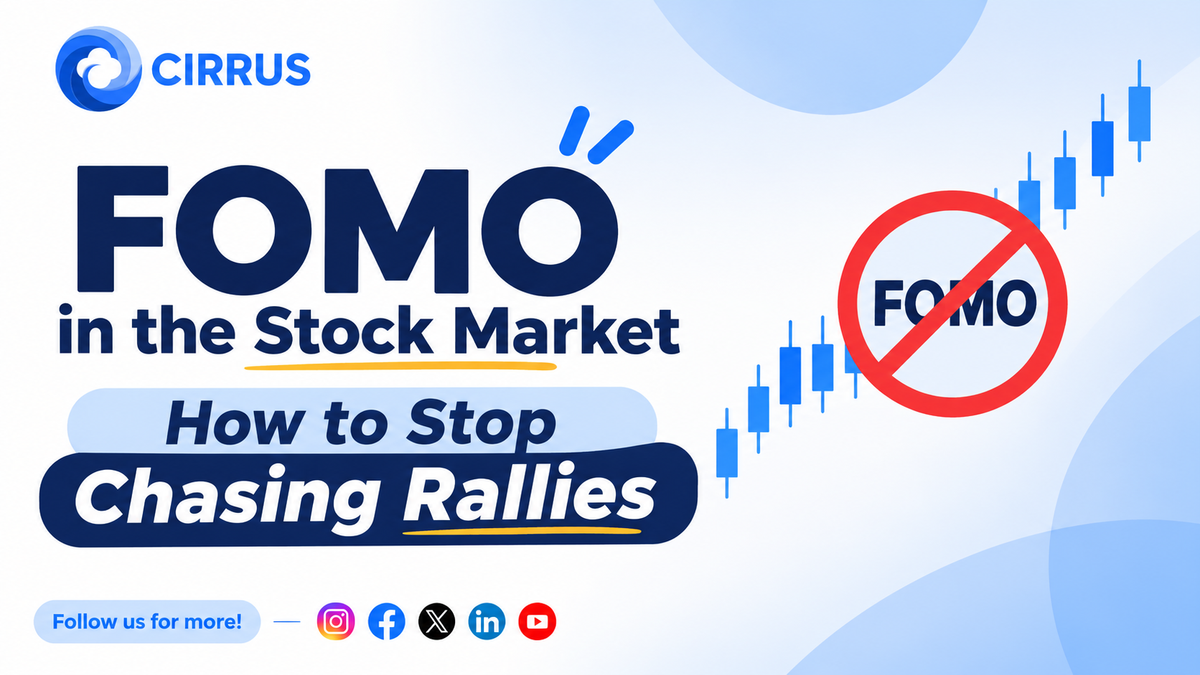
FOMO in the Stock Market: How to Stop Chasing Rallies

A stock jumps 8% in a day. Your phone fills with messages, and your friends say they bought early. You feel one thing: “If I don’t buy now, I will miss out.”
That feeling is FOMO, the fear of missing out. It is one of the most common reasons traders lose money.
What FOMO does to your trading
When a stock has already moved up sharply, most of the easy gain has often been taken. FOMO pushes you to enter late, at a high price, with little time to think.
Then the rally slows. You panic and sell at a loss. Another stock jumps, and you chase it too. This cycle repeats.
Common signs of FOMO:
- You buy only after a stock is already up a lot
- You enter without a stop loss
- You increase quantity to “make up” for a missed move
- You break your own rules “just this once”
What the numbers say
SEBI studies show how costly impulsive trading can be for individual traders in F&O:
- 87.7% of individual F&O traders had a net loss in FY26.
- Their combined net loss was about ₹91,685 crore.
- The average loss was about ₹1.17 lakh per trader.
- Options made up about 92% of the total losses.
- In FY25, 91% of individual F&O traders lost money, and combined losses were about ₹1.06 lakh crore.
Not every loss comes from FOMO. But when you buy without a plan, the risk grows.
How to stop chasing rallies
1. Decide before you enter, not after.
Write down your entry, stop loss and target before placing any order. If a trade does not fit your plan, skip it.
2. Set a stop loss every time.
A stop loss decides your maximum loss in advance, so fear cannot decide it for you.
3. Fix your position size.
Do not trade bigger to catch up on a move you missed. Use a fixed size for each trade.
4. Wait for your setup.
A missed rally is not a loss. There will be another setup. Trade only when your own rules are met.
5. Test your idea first.
Backtesting means checking how your strategy would have worked on past market data. This tells you whether your rule works before you risk real money.
6. Let rules handle the exit.
Most people enter well and exit badly. If targets and stop losses are set in advance, you do not have to make hard decisions while the price is moving.
How Cirrus helps you stick to your rules
Cirrus.trade is a trading platform that connects to your own broker account. It cannot remove FOMO, but it can help you follow your plan even when emotions rise.
- Risk management (RMS) tools: Set a target, stop loss and trailing stop loss. When the target or stop loss is hit, Cirrus exits the positions at market price. You can also set a portfolio-level target and stop loss for the day.
- Pre-trade risk checks: Add limits such as exposure limits and quantity caps, so an impulsive order does not go beyond your own rules.
- Schedule Order: Choose the time you want to enter a trade, so you act on your plan instead of the moment.
- Add or reduce quantity: Change position size across your accounts by quantity or percentage.
- Algo trading and backtesting: Run your own strategy without writing code, and test it on historical data. Backtesting is available through some brokers, such as Groww.
- Free for some brokers: Cirrus is free for m.Stock and Groww users.
You need an active demat and trading account with a supported broker to use Cirrus.
A simple routine to follow
- Before the market opens, write your plan: entry, stop loss, target.
- Set your risk rules in advance.
- Skip any stock that is already far above your entry level.
- After the market closes, review what you did and compare it with your plan.
Quick takeaway
You cannot catch every rally, and you do not need to. Traders who last are usually the ones who follow a plan, protect their downside and let rules do the hard part.
At a Glance
| Features | Chasing a Rally (FOMO) | Trading With a Plan |
|---|---|---|
| Reason for entry | “Everyone is buying” | A rule you set earlier |
| Entry price | After the big jump | Planned level |
| Stop loss | Often none | Fixed before you enter |
| Exit | Decided by fear or hope | Decided by target and stop loss |
| Position size | Bigger, to “catch up” | Fixed in advance |
| Result | Buying near the top | Controlled loss, clear targets |
Frequently Asked Questions
1. What is FOMO in the stock market?
It is the fear of missing out on a price rise, which pushes traders to buy at the wrong time.
2. Why is chasing a rally risky?
By the time you enter, much of the move may be over, and a pullback can quickly turn into a loss.
3. How do I know if I am trading on FOMO?
You are buying after a big jump, skipping your stop loss, or trading bigger than usual.
4. Does a stop loss really help?
It limits your loss on a trade to the level you chose. It does not remove risk, and fast markets can still fill orders at a different price.
5. Can Cirrus stop me from chasing rallies?
No tool can do that for you. Cirrus helps you stick to your own rules through stop losses, targets, limits and scheduled orders.
6. Do I have to know coding to use Cirrus?
No. You can trade manually, and Cirrus also supports no-code algo trading through some brokers.
7. Is Cirrus free?
It is free for m.Stock and Groww users. For other brokers, check cirrus.trade.
Disclaimer: Investments in securities markets are subject to market risks. Read all related documents carefully before investing. Scan results are not investment advice. This article is for general information only. Rules and broker policies may change, so please verify current details with your broker. Cirrus does not guarantee any outcome from automated execution.
Sources: SEBI studies on individual F&O traders (FY25 and FY26), m.Stock, Groww, 5paisa