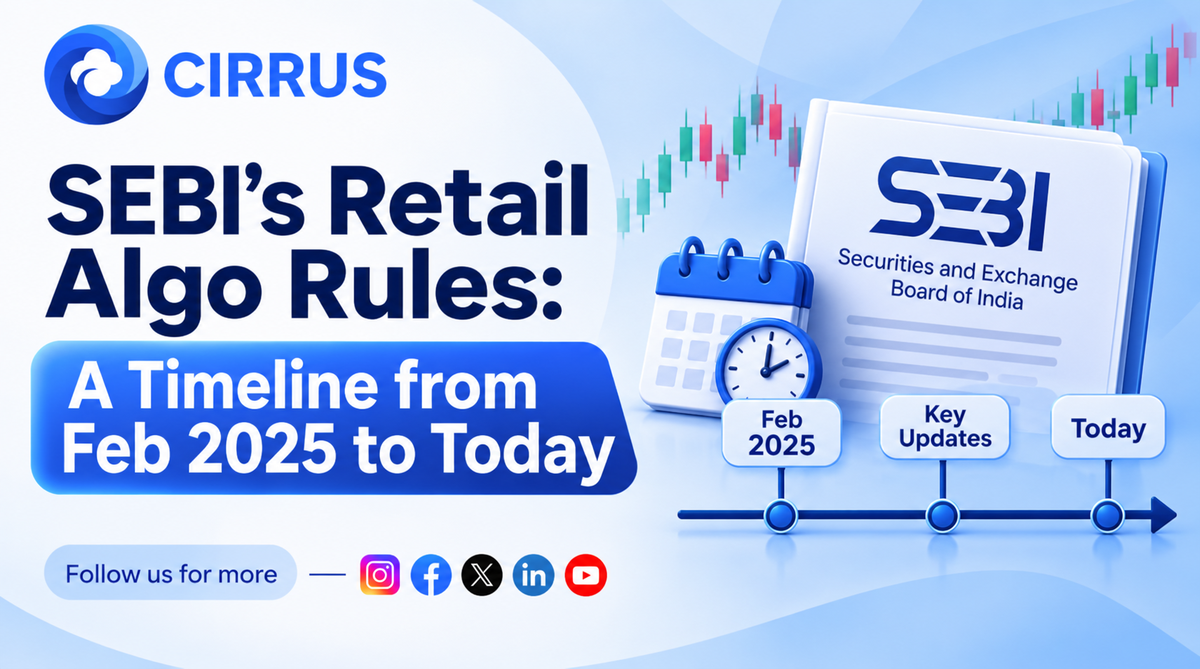
SEBI's Retail Algo Rules: A Timeline from Feb 2025 to Today
SEBI's retail algo rules took about fourteen months to go from first circular to full enforcement. Here is every date that mattered, what each one changed, and what it means for you.

The short answer
SEBI announced its retail algo rules on 4 February 2025, and they became mandatory for all stock brokers on 1 April 2026, after the start date moved twice. In between, NSE published the technical standards and SEBI added a phased rollout for brokers.
For you as a trader, the practical result is simple. API orders must come from a static IP your broker has whitelisted, API sessions end every day, and most retail strategies stay under the 10 orders per second line that triggers separate registration.
The timeline, step by step
4 February 2025: SEBI issues the framework. SEBI's circular on safer participation of retail investors in algorithmic trading set the direction. Retail investors can keep using broker APIs, but every order must be traceable. The rules were meant to start on 1 August 2025.
5 May 2025: NSE sets the technical standards. NSE's circular (NSE/INVG/67858) turned the framework into rules brokers could build. The ones you will notice:
- A static IP registered with your broker for API access. You can give one primary IP and, if you like, a second one for backup.
- The whitelisted IP can change at most once per calendar week.
- A static IP maps to one client at a time, but can be shared within a family as SEBI defines it.
- API sessions are logged out every day before the next trading day starts.
- Sign-in uses OAuth and two-factor authentication.
- A threshold of 10 orders per second per exchange. Below it, you do not need to register your algo with the broker's system.
- Every algo order, below or above the threshold, carries an identifier issued by the exchange, called the Algo-ID.
1 August to 1 October 2025: the first delay. The original start date of 1 August 2025 moved to 1 October 2025.
30 September 2025: SEBI adds a glide path. SEBI's circular (SEBI/HO/MIRSD/MIRSD-PoD/P/CIR/2025/132) let brokers that were ready go live from 1 October 2025. Everyone else got three milestones:
- 31 October 2025: apply to register at least one retail algo product and strategy.
- 30 November 2025: complete registration.
- 3 January 2026: take part in a mock trading session.
Brokers that missed the milestones could not onboard new retail clients for API-based algo trading from 5 January 2026.
1 April 2026: full applicability. The framework, together with NSE's standards and operational modalities, applied to all stock brokers. From this date every retail API order in India has to come from a static IP your broker has whitelisted.
One note on wording: NSE's text applies the 10 orders per second threshold per exchange in one section and per exchange and segment in another, so check your broker's own notice.
What it means for you today
- If you trade through an API, you need a whitelisted static IP. What Is a Static IP? covers the basics.
- Expect to sign in every day. Sessions end daily by design.
- Staying under 10 orders per second generally means no separate strategy registration. 10 Orders a Second, No Extra Paperwork explains it in plain English.
- Orders you place by hand in your broker's app or website are not affected by the static IP rule.
These rules apply to every broker and every tool, not only to Cirrus.
Why Cirrus paused and came back
Cirrus paused its service in April 2026 and rebuilt it around SEBI's rules for retail API trading. The announcement, Why Cirrus Trade has Paused all the Services, went up on 2 April 2026.
Every connected account now gets its own static IP, which you whitelist with your broker, so single-account and multi-account orders both stay within the rules. Cirrus resumed trading on 5 October 2026 with a static IP on every account. It is an NSE and BSE empanelled algo vendor. How static IP works on Cirrus has the details.
Common questions
When did SEBI's retail algo rules become mandatory? On 1 April 2026, for all stock brokers. SEBI's circular of 30 September 2025 set that date.
Why was the start date pushed back? SEBI first moved the start from 1 August to 1 October 2025, then added a glide path, citing representations from brokers and algo vendors about the system changes needed. Full applicability came on 1 April 2026.
Do I need to register my strategy? Generally no, if you stay below 10 orders per second per exchange. Above that, the strategy must be registered with the exchange through your broker.
Do the rules apply to orders I place by hand? The static IP rule is about API orders. Orders placed by hand in your broker's own app or website are not affected.
Where can I read the original circulars? Start with NSE's implementation standards and SEBI's extension circular. SEBI's circular of 4 February 2025 is on SEBI's website.
Key facts at a glance
Disclaimer
Investments in securities markets are subject to market risks. Read all related documents carefully before investing. This article is for general information only and is not investment advice or legal advice. SEBI and exchange rules and broker requirements can change, so please check the official circulars and your broker's notices before you rely on any detail here. Cirrus is a technology platform. It is not a broker and does not give investment advice.