10 Orders a Second, No Extra Paperwork: SEBI's Retail Algo Rules Made Simple

If you use a broker API, you have probably heard confusing things about SEBI's algo rules. Some say you need a licence. Some say you need to register every strategy. Others say nothing has changed.
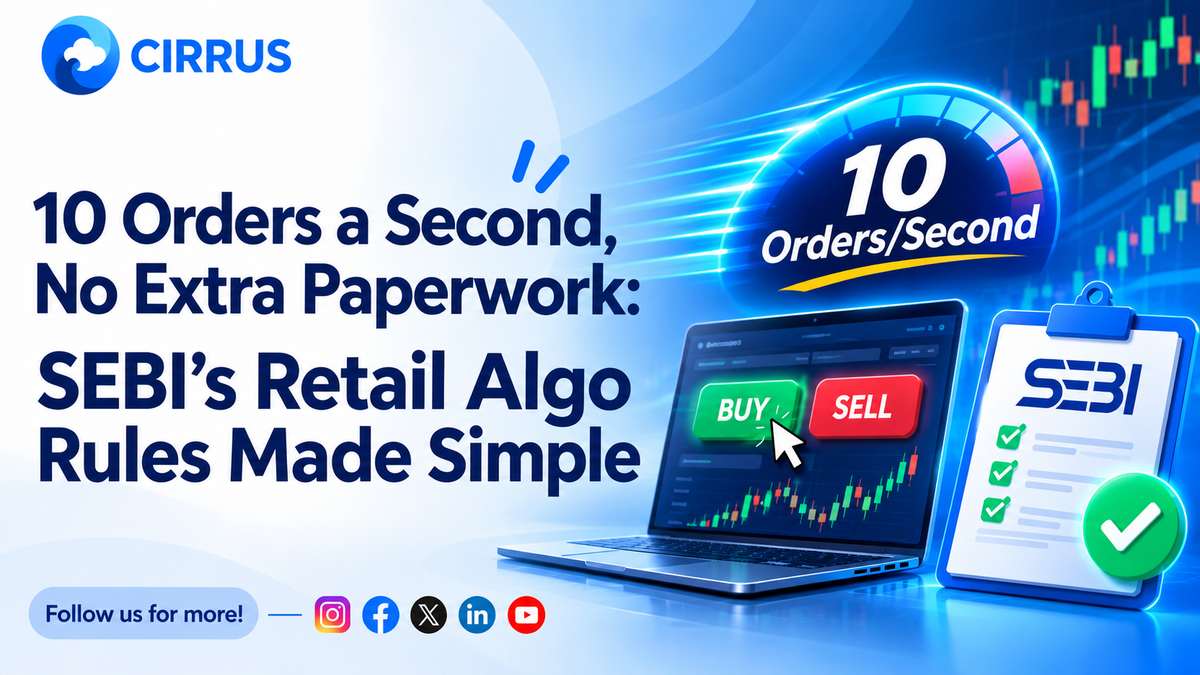
The real picture is simpler. For most retail traders, the key number is 10 orders per second.
The Short Answer: Do Retail API Traders Need to Register Their Strategies?
Generally, no, if your activity stays below 10 orders per second. SEBI's retail algo framework, mandatory from April 1, 2026, sets that threshold. Below it, you are treated as a regular API user and do not need separate exchange registration for your strategy. Static IP, daily login, and Algo-ID rules still apply.
The Rules in Plain English
- Algo-ID: Every algo order carries an exchange assigned identifier. Orders below the threshold are tagged with a generic Algo-ID applied by the broker.
- 10 orders per second: The threshold is measured per exchange, per client. It counts placements, modifications, and cancellations within a one second window.
- Static IP: You must register a static IP with your broker, and orders from other addresses are rejected. This applies even below the threshold.
- Daily login: API sessions end each day, and you authenticate again with two factor login at the start of each trading day.
- Broker responsibility: The broker is the principal and monitors order rates. Orders above the limit can be rejected.
- Black box strategies: A provider that does not disclose its logic must be a SEBI registered Research Analyst.
Sources describe the threshold slightly differently, for example per exchange or per segment, so check your broker's own notice for exact wording.
What Changed for Everyday Traders
Common Mistakes to Avoid
- Ignoring the static IP: Orders get rejected. Register it before going live and update it if your address changes.
- Assuming everyone must register: Below the threshold, you generally do not.
- Using unverified providers: Be careful with anyone promising guaranteed returns. Check registration before using their service.
- Forgetting multi-account rules: Static IP rules can differ for family accounts, so confirm sharing rules with each broker.
How Cirrus Fits Into the Picture
- Native Static IP Binding: Orders reach connected brokers through whitelisted static IP architecture, so you do not manage a server.
- Single Signal, Multi-Account Fills: One webhook becomes parallel orders for each linked account.
- Smart Lot Multipliers: Quantities scale per account using ratios you set in advance.
[CONFIRM: confirm with compliance how Cirrus describes its handling of Algo-ID and order rate limits.]
Frequently Asked Questions (FAQs)
1. When did the framework become mandatory? The retail algo framework became mandatory for brokers from April 1, 2026.
2. Do I need to register a strategy that sends fewer than 10 orders per second? Generally no. You are treated as a regular API user, though Algo-ID tagging, static IP, and daily login still apply.
3. What happens above 10 orders per second? The strategy must be registered with the exchange through your broker. Brokers also monitor order rates and can reject orders above the limit.
4. Can family members share a static IP? Some rules allow sharing within a family, subject to the broker's process, such as written consent or a verified request. Confirm with your broker.
At a Glance: Key Takeaways
What It Means for Your Setup
The framework is mainly about traceability and security. For a typical retail trader, the practical tasks are a static IP, daily login, and a compliant broker setup, not paperwork for every strategy.
The Bottom Line: Stay below 10 orders per second, register your static IP, log in daily, and use verified providers. That covers most of what retail API traders need.
Want a compliant setup without running servers? Explore how Cirrus automates multi-broker execution across major Indian brokers with built-in static IP routing at cirrus.trade.
Key Facts at a Glance for Quick Reference
Disclosure: This article is published by Kuberhunt for informational and educational purposes. Kuberhunt is a technology and research distribution platform connecting investors with SEBI registered Research Analysts and Investment Advisers. Kuberhunt itself is not a Research Analyst or Investment Adviser and does not provide investment advice, create, or endorse any specific investment recommendation. This article does not constitute investment advice, and should not be used as the basis for any buy, sell, or hold decision on any security mentioned. Readers should consult a SEBI registered professional before making investment decisions.
Data Accuracy Note: Figures are drawn from NSE, SEBI and AMFI data as reported in the sources above, as of September 2026, and may be revised. Readers are encouraged to verify current figures directly with the official releases.
Investments in securities are subject to market risks. Read all related documents carefully before investing. Registration granted by SEBI and certification from NISM in no way guarantee performance or assure returns.